
Schedule:
TIME CONTENT
8.30 – 8.35 Intro
8.35 – 8.55 Mark Kingwell: building your knowledge and expanding your circle of care
8.55 – 10:25 Workshop Period: What’s the recipe for change?
10:25 – 10:40 Break
10:40 – 11.50 Student Showcase and Q & A (with students and Mark Kingwell)
11.50 – 12.45 Lunch (featuring special recipes from our Food Services, Peggy, and ChocoSol)
Keynote Speaker:
Born into a military family in 1963, Mark Kingwell was educated in Canada, Britain, and the United States, where he completed a Ph.D. in philosophy at Yale University in 1991. He is now Professor of Philosophy and Associate Chair at the University of Toronto, a Fellow of Trinity College, and a contributing editor of Harper’s Magazine.
Mr. Kingwell has lectured extensively in Canada, the United States, Europe, the Middle East, and Australia, and has written for publications ranging from the Journal of Philosophy and Philosophical Forum to the New York Times and Auto Racing Digest. He is former columnist for Adbusters, the National Post, and the Globe and Mail. He also writes regularly about his various enthusiasms, including fly fishing, baseball, contemporary art, and cocktails. Among his fifteen books of political and cultural theory are the national bestsellers Better Living (1998), The World We Want (2000), and Concrete Reveries (2008).
Mr. Kingwell's honours include National Magazine Awards for both essays and columns, the Spitz Prize in political theory, and an honorary doctorate of fine arts from the Nova Scotia College of Art & Design for his contributions to theory and criticism. He has most recently published a collection of essays on art and philosophy called Opening Gambits, an edited volume of art and theory about public space called Rites of Way, and a philosophical biography of the pianist Glenn Gould called, appropriately, Glenn Gould. His next book, a study of the prospects for 21st-century global politics, will be called Democracy's Gift.
Engaging in Possibility: Food for Thought Workshops:
1) The Edible City
There is a lot of hype around food these days – more specifically, around the problem of creating a sustainable food system. From the 100 Mile Diet to organic to local to free range, we are starting to learn more, and care more, about how we eat – but why? What's the difference between a large industrial farm and a small-scale one? Does shopping at farmers' markets actually make a difference? Is organic food really tastier? When we are disconnected from the practice of farming, as people living in cities often are, it can be hard to grasp the significance of our food choices on the environment, our local economy, and our sense of community. In this interactive workshop you'll talk about some of these issues, and learn how simple things like how you shop, cook, and eat can be acts of environmental activism.
(Contributing writers to the book, “The Edible City”, will lead this workshop.)
2) The Starving Artist: Feeding the Muse
Poet, novelist, and professor Priscila Uppal will lead a creative workshop designed to get students talking with their poetic muse. When we produce art, what are we hungry for? How do we keep feeding this part of the self? How can this process change our lives, and the world? The workshop will also offer insight into the practicalities of the artistic life in Canada, how writers and artists literally feed their bellies. *Poetry will be written by all as part of the workshop, so please bring pens and paper and an open imagination!
*Priscila Uppal is a Toronto poet, fiction and non-fiction writer born in Ottawa in 1974. Among her critically-acclaimed publications are five collections of poetry, including most recently, Live Coverage (2003), and Ontological Necessities (2006; shortlisted for the prestigious $50,000 Griffin Poetry Prize); the novels The Divine Economy of Salvation (2002) and To Whom it May Concern (2009), and the academic study We are What we Mourn: The Contemporary English-Canadian Elegy. Her work has been published internationally and translated into Croatian, Dutch, Greek, Korean, Latvian, and Italian. She has a PhD in English Literature and is professor at York University in Toronto. Forthcoming in 2010 are Traumatology, a new book of poetry with Exile Editions, and Successful Tragedies, selected poetry, with Bloodaxe Books U.K.
3) Nutrition for the Lungs
We know that to live life fully and freely is an art, requiring skills, intuition, creativity and knowledge, but how do we ensure we live those values individually? In a complex world, how do you stay calm, cool, and collected while trying to tackle some of the issues we face? The Art of Living Foundation believes in strengthening the individual to address this question, and creates the space to do this by teaching skills specifically related to breath and yoga. Oxygen is food, and this workshop will help you explore Food for Thought from an individual and health perspective. *Bring comfortable clothes you can move freely in!
4) The Rhythm of the Feast
New Years Eve, Birthdays, Funerals, Weddings – every time we want to celebrate something we eat, we dance and we sing. It seems to be in our nature as human beings to connect these disciplines in a multitude of ways in our world. Food, music and celebration have been a part of shared humanity since the beginning. So, how do you celebrate? How do you welcome a stranger into your culture? Join Professor Kwasi Dunyo as he guides us through the intricacies embedded in the relationship between culture and music.
5) The Story of Food
Food Sovereignty is about putting control of food back in the hands and bellies of people. Though enough food is grown to feed the world, there is much to do to fix the global food system. This lively, interactive workshop will bring out the dynamics and politics of food, demanding each of us think harder and act deeper to promote food justice. We will explore and talk about questions such as: ‘Does what I eat cause hunger or injustice somewhere? Here? There?’ and ‘Where are the role models for the world we do want – with enough good food for all?’ The workshop starts with pictures and stories from the global food justice/food sovereignty activities of USC Canada (www. usc-canada.org), then moves into games and resources for taking action – among them ‘Story of Food’.
6) Food Architecture
Whether we know it or not, agricultural issues have an impact on the design of urban spaces and buildings. So, how can the design of cities, urban landscapes, buildings, and gardens facilitate the production of food in cities (especially ours)? What role can design play in strengthening the links between urban environments and food? “Carrot City” – a collection of people and ideas that use design to enable sustainable food production – is an initiative housed at Ryerson University. Workshop facilitators from this project will share with you how they are helping to re-introduce urban agriculture to our cities, and what you can do to get involved.
7) Meal Exchange
In the past, how have young people changed the world? In the present, what have young rabble-rousers done to address the things they care about? Drawing on the examples of food security and the global food system, you will leave this workshop understanding what social change is, the possibilities for changing the food system, and how 21st century technology and the legacy of past youth movements have changed the way young people can advocate for change.
*Dave Kranenburg, the facilitator of this workshop, is the Executive Director of Meal Exchange, an organization he helped create when he was 19. Meal Exchange is an exciting national youth-led organization committed to eliminating local hunger and is well known for its work with food security and supporting the development of youth leaders and change-makers.
8) Peggy’s Recipe for Change
Can uncovering your true potential and purpose in life be found by making small changes to your favourite cookie recipe? Absolutely. Nutritionist and Culinary Consultant, Peggy Kotsopoulos, will take you through a delicious workshop that taps into the role food plays in our ability to make decisions, pursue happiness and develop the courage and clarity to live the life we want. You will learn about the energy food and how it feeds our soul, our cells, our thought process, and of course, our cravings! You will also get to take part in a food demonstration and sample how scrumptious living your passion can be. So come with an appetite for change and tasty treats!
9) Kids Against Canadian Hunger
Darren Cole, grade 11 student, understands that world hunger is a big issue. Knowing this, he created a charity called Kids Against Canadian Hunger (K.A.C.H.) despite his busy high school schedule. How did he do this? How do you connect with people that will support your idea, how do you maintain that network, and how do you balance your school obligations with running your own charity? In this workshop, learn from Darren about how he turned his passion into action and how the community council got connected to him and the work that he’s doing. *Cookie decoration will take place!
10) Bridging the Gap: Hunger & Food Waste
Every day in Toronto thousands of people cannot afford to buy food for themselves or their family. At the same time, thousands of pounds of edible food is thrown away. Second Harvest operates under the principle that if we rescue food that is going to landfill, there is enough to feed everyone. In this workshop, you will learn why there are so many people in our city in need of food assistance, explore solutions for change and brainstorm new ideas for ensuring everyone has access to the food they need. Become part of the solution to hunger and food waste in our city.
11) What Toronto Eats
How do people around Toronto eat? What does it cost to feed a family healthy food for a week? What kind of nutrition are people getting? Through powerful photos of various family diets from the What Toronto Eats exhibit, and by role-playing grocery shopping scenarios in different neighbourhoods, we'll explore the factors that influence the cost of food in our city.
FoodShare's mandate is to work with communities to improve access to healthy and affordable food from field to table. The Recipe for Change Campaign encourages real change to happen in schools – from food with flavour in cafeterias, to real world food skills like gardening and cooking in the classroom. Come get inspired and fired up about the kind of changes you can make in your world when it comes to food.
12) ChocoSol: Sustainable, Equitable Business
Six years ago Michael Sacco showed up in Oaxaca, Mexico with an idea for a solar coffee roaster that would be "useful and profitable". Working with local farmers, he built a solar concentrator based on the designs of Canadian inventor Fraser Symington and started trying to roast chocolate. With his success, he decided to set up a partnership with the local farmers and brought their products to the Toronto market! So how does one invite and delight people with a delicious and nutritious product line? How do you address current problems relating to ecology, inequality, and interculturality through chocolate? Come make and talk chocolate, social justice and innovation in this workshop!
13) Policing the Food Policies in Our City
The Toronto Youth Food Policy Council partners with business and community groups in Toronto to develop policies and programs promoting food security. But why do we need a Food Policy Council in the first place? What does that look like? Can a food system that fosters equitable food access, nutrition, community development and environmental health come out of such a council? Come to this workshop to work with members of the youth council to find out how you can make impact at a policy level, how to use the tool of “community mapping”, and what it’s like to sit on a council of the City of Toronto!
14) Do the Math
Poverty in Ontario is at an all time high. As the economic crisis grows, so does the number of people relying on social assistance and food banks in Toronto. The Civic Engagement program at The Stop Community Centre asks us: does a single person on social assistance receive enough income to live with health and dignity? Do The Math to find out! This workshop will include a discussion of the causes and circumstances that lead people to use emergency food programs like food banks and consider what we can do collectively to ensure that no one in our province goes hungry.
15) Harmoniously Moving
Harmony Movement’s focus is on diversity and equity using media literacy as a tool. Through all of the programming that they offer, they support people in learning about themselves and understanding what makes them who they are. “Before we can even begin to understand the world around us,” they say, “we need to know who we are, first.”
In this workshop, participants will uncover how the media shapes their understanding of consumption in Toronto, in North America, and in the world, and they will learn how to question society's understanding of poverty and inequity in certain communities. This interactive workshop will allow for difficult questions such as - What is poverty? Who is poor? Who stays poor? - to be discussed. Students will not only identify concepts such as racialized poverty and classism, but they will also learn how to be an advocate to create necessary change. Participants will learn about individuals and organizations that are making a difference, and will create strategies to raise awareness and to combat discriminatory attitudes and behaviours in their school and community.
16) The Three Sisters: corn, beans, and squash
Agriculturalists in our Iroquoian culture had ceremonies for the seeds and to celebrate the cycle of the planting season. Do these ceremonies still exist? Bill Woodworth, architect and Mohawk traditionalist, returns to Havergal to explore this tradition, sharing with us the theme of The Three Sisters – corn, beans, and squash – their origins in Creation, and their integrated use in many things.
17) Change for Change: Feeding Canada's athletes
Did you know that many of Canada's top athletes have to go to food banks to get enough to eat? Many of Canada's athletes (the ones we'll be cheering for in Vancouver!) scrape by, living close to the poverty line.
Olympian and Old Girl Alexandra Orlando, is joining us to share her work with Athletes CAN, an organization founded and led by athletes, dedicated to creating the support athletes need to maximize their capabilities. Explore the activist in the athlete in this dynamic session – stretch your body and your mind!
18) Sport for Community Development
Does sport build social cohesion? How does playing allow us to realize our shared humanity? Concrete Hoops is a local non-profit organization that uses sport to create social change and build leadership in young people. Their philosophy of sport is that it is capable of reducing barriers and increasing community participation in a positive way – through play! Join them in learning ways to use sport for community development and social inclusion.
19) Youth Voices
What is the connection between story-telling, water, health and well-being, and food? Are these topics (or “systems”) connected? Does it matter? Youth Voices, a project at the School of Public Health at the University of Toronto, argues that each of these things are connected and have the power to effect every aspect of our personal and community health. Join this vibrant group of young people to learn how to explore global capability, identify problems, and create community action.
20) Connect the dots: Creating Food Security in Ontario
Local farmers’ markets, community and school gardens, food co-ops, urban gardens, farmer training programs, Alternative Land Use Services, new certification regimes - all of these emerging possibilities support healthier, tastier food for all. As this happens, everyone benefits and communities become stronger and more inclusive.
So, how do we create the conditions for these initiatives to flourish?
Sustain Ontario strengthens food and farming networks, showcases food system innovations and champions, and presses for policy reform. In this workshop you will see how your personal food choices link to the good food revolution happening at regional, provincial and federal levels.
21) Living and Giving: The Social Entrepreneur
What does it take to be a social entrepreneur? This workshop will look at what it takes to embark on a journey to create and sustain an enterprise whose prime purpose is to have social value. What are the characteristics of the social entrepreneur? Do you think you might have them? We will look at some of the difficulties that can be encountered in starting such a business. We will also look at the profiles of some young successful social entrepreneurs. We will finish the workshop by blue skying some ideas for actual social entrepreneurship businesses.
Teresa Woods Snelgrove (1964) has been a serial entrepreneur in a variety of arenas: she is a co-founder of Timothy’s World Coffees, Chapters Bookstore/Café, After Graduation, General Wellbeing, and Snelgrove Associates. Some of these ventures were successful; others were not. She has recently been appointed President of ProFitHR, a spinout company from McMaster University and is hoping to take it to its next stage of growth.
22) Growing Future Friendly Products
Agricultural researchers in Canada and around the world know there are better ways to produce things like plastic bags, utensils, cups, plates and other (currently) wasteful materials. But the question is: can it only be done only at the expense of crops grown for food? Find out about biodegradable plastics produced from plant starches, fuels and lubricants that burn clean and efficiently and are non-polluting, and what you can do to change the world via science – agricultural science! Through this workshop you will see, touch and feel what plants offer us to fuel our future from Andrea Labaj, a scientist, educator, and researcher for Agriculture and Agri-Food Canada.
23) Charting Your Own Destiny
Wahn Yoon, President of non-traditional advertising agency Wunderkind, believes that to be effective in the world requires authenticity and self-direction. So, how do you chart your own authentic destiny? In this workshop, Mr. Yoon will share his story (how he came to work in advertising and his unorthodox career path toward it), an example of a new campaign he’s involved with called: Because I am a Girl, and what actions you can take to determine (and apply) your values, aspirations, and dreams to something you care about.
24) "What makes you think you can make a difference?"
Two and a half millennia after his death, the ancient Greek philosopher Socrates is remembered for his commitment to philosophical questioning. Prowling the marketplace of Athens, he engaged his fellow citizens in debate about the meaning of life by asking provocative questions. He was revered and feared, and died drinking hemlock after an Athenian court sentenced him to death for "praising false gods" and "corrupting the youth of Athens."
Clearly he was someone who made a difference. In this session, we will discuss the underlying questions that attend all issues of social justice. What makes us think we can make a difference? What counts as a difference? How do we get started? How do we go on? How do we deal with the consequences? This may lead to some discomfort, a frequent result of Socratic dialogue, but no hemlock will be consumed in the course of this session. *Mark Kingwell will be facilitating this session.
25) Food as a Human Right?
Amnesty International is an independent global movement of over 2 million people in more than 150 countries and territories who campaign to end grave abuses of human rights. Amnesty’s work is based on the United Nations Universal Declaration of Human Rights and originally focused on political and civil rights. In the past decade the organization has moved to included economic, social, and cultural goals as issues of human rights. In this workshop Dorothea Manson, a longtime Amnesty volunteer, will introduce Amnesty’s work and activities, and relate the Millennium Development Goals to its mandate. Participants will create written actions like letters and petitions and brainstorm other activities to show food issues in the context of human rights.
26) Project: Humanity - Elephant Hunters
Change occurs through Action. Action is provoked by Discussion. Discussion is stimulated through emotional reactions. Theatre makes Change by emotionally affecting its audience. This workshop will show you how you can use theatre as a tool for social change. The 'elephant in the room' is the problem that we are afraid to discuss. Maybe we don't know how, don't know what to say, or don't know how others will react to it. But the more we avoid it, the more we empower it. Through theatre, Project: Humanity will guide you through an exploration of how to create and use theatre that identifies, addresses and attacks the elephant in the room.
27) Women Moving Women Out of Poverty
Poverty is one of the many reasons why people go hungry in Canada. One in seven women in Canada lives in poverty.
A groundbreaking campaign by the Canadian Women’s Foundation has the goal to help 2500 women and their families on their journeys out of poverty. The funds raised by this campaign provide low-income women with the skills, resources, and confidence they need to gain economic independence and stop the cycle of poverty. The CWF knows that when you invest in women, you are investing in your community, and when you invest in your community, you make a more prosperous country for everyone.
You’ll meet Leigh Naturkach, CWF manager, and one of the CWF-funded past program participants, Mary-Catherine Zwambag. Mary-Catherine has her own business, Miss Fix It, and she will demonstrate the skills she learned through a CWF-funded program and how it changed her life.
28) Me to We
You’re inspired and motivated to change the world – now what? Me to We Leadership facilitators will coach you through WAKE, an awareness-raising process that will give you tangible ways to put your passion into action. Founded in 1999 by international spokespeople for change, brothers Craig and Marc Kielburger, Me to We Leadership delivers leadership training experiences to more than 350,000 youth every year. Take your leadership skills to the next level and be the change!
29) It's so Easy Living Green
Being "eco-conscious" means being aware of what you are doing, buying, using, and what it does to the environment. Do you want to be more eco-conscious, but don't know where to start? This motivating workshop will teach you fun and simple ways to improve your health and the health of the planet, a true recipe for change. Join Havergal Old Girl, Lesley Stoyan (1990), Director and owner of Daily Apple, to learn how easy living green can actually be!
30) Faithfully Fed: finding a balance in complexity
A panel discussion with people who practice various faith traditions, including the Christian, Buddhist, Jewish, and Muslim perspectives. These panelists will explore the journey of food through food preparation (ie. growing/buying), how we demonstrate our value and thanks for food (ie. how we "bless" our food), and how we consume it (ie. why do certain traditions not eat certain foods together, for example). Panelists will also explore how our personal values fit into this picture (How do we choose what we eat? How do we value food? What impact does it have?)
The Educator’s Food for Thought: Resources for the Classroom
(*for teachers only*)
Ontario Agri-Food Education Inc. (OAFE) is a not for profit, registered charity dedicated to enhancing the learning experiences of students by providing educators with high quality, objective and curriculum-linked agriculture and food related learning materials. This workshop will highlight a variety of OAFE resources on sustainability, stewardship, healthy eating, and global food issues, and will demonstrate how these topics can be integrated into the curriculum to further support student learning resulting from the Food for Thought Conference. Each participant will receive a complimentary package of OAFE resources to use in the classroom.
Wednesday, December 16, 2009

Tuesday, December 1, 2009
Food for Thought Workshop: ChocoSol

ChocoSol - a sustainable, equitable business - will be coming to Havergal College on January 13th as part of a half-day conference called Food for Thought.
What's ChocoSol all about?
Six years ago Michael Sacco showed up in Oaxaca, Mexico with an idea for a solar coffee roaster that would be "useful and profitable". Working with local farmers, he built a solar concentrator based on the designs of Canadian inventor Fraser Symington and started trying to roast chocolate. With his success, he decided to set up a partnership with the local farmers and brought their products to the Toronto market! During his workshop on Jan. 13th, he will explore questions like, how does one invite and delight people with a delicious and nutritious product line? How do you address current problems relating to ecology, inequality, and interculturality through chocolate? Get excited to make and talk chocolate, social justice and innovation in his workshop in the New Year!
(Below is a video that Anika Roberts Stahlbrand, grade 12 student, produced for a class project at her school.)
Monday, November 30, 2009
Food for Thought in the Junior School
 Celebrating year of food in the classroom...
The girls have been sharing their family stories/traditions through food this year. Cultural recipes, foods that bring back memories of their Grandma, the first food they helped make...
These are photos from a lasagna feast in the classroom on November 26th!


Thursday, November 19, 2009
The Story of Food
USC Canada’s new short, animated film will get you thinking about our broken food system. It identifies what’s gone wrong, and what we can do to rebuild it.
The Story Of Food from USC Canada on Vimeo.
What Can You Do?
- Think about how our food is produced and where it comes from.
- Buy local, organic, and fair trade whenever you can.
- Support small scale farmers who grow healthy food around the world.
- Make your voice heard by joining the worldwide movement to change our food system.
Together, we can build a healthy food system…for everyone! Stay tuned for more resources, information, and action alerts.
To start you thinking, here is a quote from Canadian writer and journalist Thomas Pawlick:
“Right now, if you go to the produce section of any supermarket – anyone at all – and buy fruit or vegetables, or cottage cheese, or meat, you would have to eat something like five times as much of that food to get the same amount of vitamins and minerals as your parents or grandparents got in the 1950s.” ---------------------------------------------------------------------------------------------------------------
The Story of Food might remind you of "The Story of Stuff", a clever commentary on the story of production and consumption in our world. This was something introduced a few years ago during "The Year of the Story", the Institute's first annual focus in 2005. Here it is again:
For more information on this project, visit: www.storyofstuff.org
Tuesday, November 17, 2009
The Institute's "Lunch n' Learn" Workshop Series - Report Back!
Peggy Kotsopoulos, Registered Holistic Nutritionist, Culinary Consultant, Health Educator, and the Founder and Director of beVibrant wellness consulting, came to Havergal to speak to our community on September 25th. Since then she has joined the Institute's year-long focus on "Food for Thought" by offering 4 workshops about healthy (and creative) alternatives to some of our favorite recipes!
Below is a sample of one of the workshops that she delivered that explored the various ways we can look at and experience the "positive energy of real food". Also included below are the recipes that Peggy demonstrated in each of her workshops! Bon appétit!
***Peggy's final workshop will take place at lunchtime on Friday November 20th in the Forum for Change. If you would like to secure your spot, please email Melanie at: mmacdonald1@havergal.on.ca***
Below is a sample of one of the workshops that she delivered that explored the various ways we can look at and experience the "positive energy of real food". Also included below are the recipes that Peggy demonstrated in each of her workshops! Bon appétit!
***Peggy's final workshop will take place at lunchtime on Friday November 20th in the Forum for Change. If you would like to secure your spot, please email Melanie at: mmacdonald1@havergal.on.ca***
Sunday, November 8, 2009

Saturday, November 7, 2009
"There are so many ways to help improve our communities. Big or small, every step makes a difference."
The Aviva Community Fund has organized a competition to support what's important to people in Canada by helping them make a positive change in their communities. How? Through the Aviva Community Fund competition. This competition is giving people the chance to voice an idea that will create a lasting change in a community. The most popular ideas, as chosen by Canadians, will have a chance at sharing in the $500,000 Aviva Community Fund. If you check out the site, the ideas that are listed are a inspiring examples of people turning their ideas into action...
Here is the link:Aviva Community Fund
Thursday, October 22, 2009
Answers to Food for Thought Questionnaire!
Haven't done the questionnaire yet? Click here!
Question 1: What is the first Millennium Development Goal (MDG)?
• to eradicate extreme poverty and hunger
• to halve, between 1990 and 2015, the proportion of people whose income is less than 1 dollar a day
• to achieve full & productive employment & decent work for all, including women & young people
• to halve, between 1990 and 2015, the proportion of people who suffer from hunger
• none of the above
• all of the above
→ THE CORRECT ANSWER IS: all of the above
Question 2: True or false? The right to adequate food is a human right, inherent in all people, to have regular, permanent and unrestricted access, either directly or by means of financial purchases, to quantitatively and qualitatively adequate and sufficient food corresponding to the cultural traditions of people to which the consumer belongs, and which ensures a physical and mental, individual and collective fulfilling and dignified life free of fear.
→ THE CORRECT ANSWER IS: True. Visit this link for more information: Right to Food.
Question 3: What type of food do require the most of in our diets?
• Good Fats
• Complex Carbohydrates (Vegetables, fruit, and starches)
• Candy
• Protein
→ THE CORRECT ANSWER IS: Carbohydrates
Each meal consumed in a day should be 50%-60%carbohydrates (which is the size of one closed hand with the other hand grasping it), 25%-30% proteins (the size of your palm) and 15%-20% healthy fats (approximately the size of a shot glass for nuts or 1/2 shot glass for oils).
Question 4: Where does the world's food crop diversity come from? (What are the major centres of origin?)
• our food crop diversity comes from North America
• our food crop diversity comes from farms, fields and forests in the tropics and sub-tropics
• our food crop diversity comes from Lobaws and other major grocery stores
• none of the above
• all of the above
→ THE CORRECT ANSWER IS: Our food crop diversity comes from farms, fields and forests in the tropics and sub-tropics — where rural communities first domesticated species and where they have been nurtured for millennia.
Question 5: How many countries now require emergency food assistance?
→ THE CORRECT ANSWER IS: 30. Visit this link for more information: Globe and Mail article
• 30
• 107
• 15
• 48
• none of the above
Question 5: How many people in the world are unnourished this year?
• 60 thousand
• 1.02 billion
• 2.05 billion
• 300 thousand
• none of the above
→ THE CORRECT ANSWER IS: 1.02 billion. Visit this link for more information: Globe and Mail article
Question 6: Which type of chocolate is the healthiest?
• White Chocolate
• Milk Chocolate
• Dark Chocolate
• None
→ THE CORRECT ANSWER IS: Dark Chocolate
White chocolate doesn't even contain cocoa, it is pure sugar. Milk chocolate is hardly any better. Dark chocolate has more antioxidants than blueberries, so it should be eaten every so often in moderation because it still contains some sugar.
Question 7: After dropping steadily since 1969, the number of undernourished people in the world today has recently started to rise. Is this because of:
• a decline of investment in agriculture
• high food prices
• global financial meltdown
• all of the above
• none of the above
→ THE CORRECT ANSWER IS: all of the above. Visit this link for more information: Globe and Mail article
Question 8: Think about the difference between providing FOOD AID and AGRICULTURE AID.
Now - True or false: delivering FOOD to people versus INVESTING in farming and new agricultural technology is a more sustainable act to make a difference in the lives of people who are undernourished.
• True
• False
• The answer is complex
à THE CORRECT ANSWER IS: …that the statement is complex because there are many systems (social, economic, and environmental) at play.
When thinking about emergency food aid versus agriculture aid or development assistance, consider:
1. Where we are now (-the number of undernourished people is increasing in the world);
2. Where we need to be going (-halving the number of people hungry in the world by 2015), and;
3. How we are going to get there.
Emergency food aid does not develop the capabilities of the people that it is providing for. The food provided may also not be culturally and religiously appropriate. However, if people are dying from starvation, the first response will be to provide them with food. If people are not starving, but are severely malnourished, what is the best response? Perhaps, in those cases, emergency food assistance, coupled with agricultural development assistance. By investing in agriculture through agricultural development assistance, do we create an opportunity for people to find ways of providing food for themselves on their on terms, their own land, and their own time?
These are the questions to ask when thinking about sustainable action (and making a difference). Remember: the “answers” depend on the particular context under consideration.
“Give a person a fish; you have fed them for today. Teach a person to fish; and you have fed them for a lifetime.” -Author unknown
Question 9: Please read the following two statements:
- The Green Revolution increased food production and led to reduction in hunger.
- The Green Revolution developed mono-culture and left people dependent on seed companies.
That said, did the green revolution contribute to the current food crisis?
• Yes
• No
• The answer is complex
→ THE CORRECT ANSWER IS: …that the answer is complex.
From Wikipedia: (http://en.wikipedia.org/wiki/Green_Revolution)
The effects of the Green Revolution on global food security are difficult to understand because of the complexities involved in food systems.
The world population has grown by about four billion since the beginning of the Green Revolution and many believe that, without the Revolution, there would have been greater famine and malnutrition. India saw annual wheat production rise from 10 million tons in the 1960s to 73 million in 2006. The average person in the developing world consumes roughly 25% more calories per day now than before the Green Revolution. Between 1950 and 1984, as the Green Revolution transformed agriculture around the globe, world grain production increased by over 250%.
The production increases fostered by the Green Revolution are widely credited with having helped to avoid widespread famine, and for feeding billions of people.
There are several claims about how the Green Revolution may have decreased food security for some people. One claim involves the shift of subsistence-oriented cropland to cropland oriented towards production of grain for export or animal feed. For example, the Green Revolution replaced much of the land used for beans and legumes that fed people for wheat, which did not make up a large portion of their diet.
Question 10: What is the impact of climate change on food supply?
• rising sea levels will threaten more than 630 million people who live on coastal lowlands – where two-thirds of the world’s largest cities are located
• there will be more precipitation at high altitudes which will lead to more plant disease and pest outbreaks.
• susceptible drylands will experience a rise in surface temperature and crop yields will drop dramatically where dryland agriculture depends completely on rain.
• higher temperatures will cause severe storms and floods, melt glaciers and ice caps and make sea levels rise.
• none of the above
• all of the above
→ THE CORRECT ANSWER IS: all of the above!
Question 11: What is food security?
• everyone has enough food to eat.
• everyone can eat when they want, where they want.
• people have access to sufficient, safe, nutritious food to maintain a healthy and active life at all times.
• people are able to eat the food that is culturally conscious and considerate.
• none of the above
• all of the above
→ THE CORRECT ANSWER IS: all of the above!
Question 12: Who supports the Millennium Development Goals?
• President Obama
• Bono
• Gro Brundtland
• none of the above
• all of the above
→ THE CORRECT ANSWER IS: all of the above!
Question 1: What is the first Millennium Development Goal (MDG)?
• to eradicate extreme poverty and hunger
• to halve, between 1990 and 2015, the proportion of people whose income is less than 1 dollar a day
• to achieve full & productive employment & decent work for all, including women & young people
• to halve, between 1990 and 2015, the proportion of people who suffer from hunger
• none of the above
• all of the above
→ THE CORRECT ANSWER IS: all of the above
Question 2: True or false? The right to adequate food is a human right, inherent in all people, to have regular, permanent and unrestricted access, either directly or by means of financial purchases, to quantitatively and qualitatively adequate and sufficient food corresponding to the cultural traditions of people to which the consumer belongs, and which ensures a physical and mental, individual and collective fulfilling and dignified life free of fear.
→ THE CORRECT ANSWER IS: True. Visit this link for more information: Right to Food.
Question 3: What type of food do require the most of in our diets?
• Good Fats
• Complex Carbohydrates (Vegetables, fruit, and starches)
• Candy
• Protein
→ THE CORRECT ANSWER IS: Carbohydrates
Each meal consumed in a day should be 50%-60%carbohydrates (which is the size of one closed hand with the other hand grasping it), 25%-30% proteins (the size of your palm) and 15%-20% healthy fats (approximately the size of a shot glass for nuts or 1/2 shot glass for oils).
Question 4: Where does the world's food crop diversity come from? (What are the major centres of origin?)
• our food crop diversity comes from North America
• our food crop diversity comes from farms, fields and forests in the tropics and sub-tropics
• our food crop diversity comes from Lobaws and other major grocery stores
• none of the above
• all of the above
→ THE CORRECT ANSWER IS: Our food crop diversity comes from farms, fields and forests in the tropics and sub-tropics — where rural communities first domesticated species and where they have been nurtured for millennia.
Question 5: How many countries now require emergency food assistance?
→ THE CORRECT ANSWER IS: 30. Visit this link for more information: Globe and Mail article
• 30
• 107
• 15
• 48
• none of the above
Question 5: How many people in the world are unnourished this year?
• 60 thousand
• 1.02 billion
• 2.05 billion
• 300 thousand
• none of the above
→ THE CORRECT ANSWER IS: 1.02 billion. Visit this link for more information: Globe and Mail article
Question 6: Which type of chocolate is the healthiest?
• White Chocolate
• Milk Chocolate
• Dark Chocolate
• None
→ THE CORRECT ANSWER IS: Dark Chocolate
White chocolate doesn't even contain cocoa, it is pure sugar. Milk chocolate is hardly any better. Dark chocolate has more antioxidants than blueberries, so it should be eaten every so often in moderation because it still contains some sugar.
Question 7: After dropping steadily since 1969, the number of undernourished people in the world today has recently started to rise. Is this because of:
• a decline of investment in agriculture
• high food prices
• global financial meltdown
• all of the above
• none of the above
→ THE CORRECT ANSWER IS: all of the above. Visit this link for more information: Globe and Mail article
Question 8: Think about the difference between providing FOOD AID and AGRICULTURE AID.
Now - True or false: delivering FOOD to people versus INVESTING in farming and new agricultural technology is a more sustainable act to make a difference in the lives of people who are undernourished.
• True
• False
• The answer is complex
à THE CORRECT ANSWER IS: …that the statement is complex because there are many systems (social, economic, and environmental) at play.
When thinking about emergency food aid versus agriculture aid or development assistance, consider:
1. Where we are now (-the number of undernourished people is increasing in the world);
2. Where we need to be going (-halving the number of people hungry in the world by 2015), and;
3. How we are going to get there.
Emergency food aid does not develop the capabilities of the people that it is providing for. The food provided may also not be culturally and religiously appropriate. However, if people are dying from starvation, the first response will be to provide them with food. If people are not starving, but are severely malnourished, what is the best response? Perhaps, in those cases, emergency food assistance, coupled with agricultural development assistance. By investing in agriculture through agricultural development assistance, do we create an opportunity for people to find ways of providing food for themselves on their on terms, their own land, and their own time?
These are the questions to ask when thinking about sustainable action (and making a difference). Remember: the “answers” depend on the particular context under consideration.
“Give a person a fish; you have fed them for today. Teach a person to fish; and you have fed them for a lifetime.” -Author unknown
Question 9: Please read the following two statements:
- The Green Revolution increased food production and led to reduction in hunger.
- The Green Revolution developed mono-culture and left people dependent on seed companies.
That said, did the green revolution contribute to the current food crisis?
• Yes
• No
• The answer is complex
→ THE CORRECT ANSWER IS: …that the answer is complex.
From Wikipedia: (http://en.wikipedia.org/wiki/Green_Revolution)
The effects of the Green Revolution on global food security are difficult to understand because of the complexities involved in food systems.
The world population has grown by about four billion since the beginning of the Green Revolution and many believe that, without the Revolution, there would have been greater famine and malnutrition. India saw annual wheat production rise from 10 million tons in the 1960s to 73 million in 2006. The average person in the developing world consumes roughly 25% more calories per day now than before the Green Revolution. Between 1950 and 1984, as the Green Revolution transformed agriculture around the globe, world grain production increased by over 250%.
The production increases fostered by the Green Revolution are widely credited with having helped to avoid widespread famine, and for feeding billions of people.
There are several claims about how the Green Revolution may have decreased food security for some people. One claim involves the shift of subsistence-oriented cropland to cropland oriented towards production of grain for export or animal feed. For example, the Green Revolution replaced much of the land used for beans and legumes that fed people for wheat, which did not make up a large portion of their diet.
Question 10: What is the impact of climate change on food supply?
• rising sea levels will threaten more than 630 million people who live on coastal lowlands – where two-thirds of the world’s largest cities are located
• there will be more precipitation at high altitudes which will lead to more plant disease and pest outbreaks.
• susceptible drylands will experience a rise in surface temperature and crop yields will drop dramatically where dryland agriculture depends completely on rain.
• higher temperatures will cause severe storms and floods, melt glaciers and ice caps and make sea levels rise.
• none of the above
• all of the above
→ THE CORRECT ANSWER IS: all of the above!
Question 11: What is food security?
• everyone has enough food to eat.
• everyone can eat when they want, where they want.
• people have access to sufficient, safe, nutritious food to maintain a healthy and active life at all times.
• people are able to eat the food that is culturally conscious and considerate.
• none of the above
• all of the above
→ THE CORRECT ANSWER IS: all of the above!
Question 12: Who supports the Millennium Development Goals?
• President Obama
• Bono
• Gro Brundtland
• none of the above
• all of the above
→ THE CORRECT ANSWER IS: all of the above!
Monday, October 5, 2009
STUDENTS APPLICATIONS OPEN for the Global Experience Program!
 ***Please attend the parent and student information evening on October 15th at 6:30 to 8.30 p.m. in the Ellen Knox library!***
This year, the Global Experience Program is offering THREE trips to South Africa and one to China.
1) NOAH, SOUTH AFRICA
In the summer of 2010, tentatively from July 30th to August 21st, selected students and accompanying faculty will travel to work with Havergal's project partnership with Durban Girls College (a Havergal Exchange partner) and NOAH in Durban, South Africa. This trip will extend the relationships initiated in the summer of 2009 when 9 students and 2 teachers worked with NOAH.
2) ORANGE RIVER/CAPETOWN, SOUTH AFRICA
Over March break, from March 4th to March 21st, 2010, selected students will travel with Ms. Whitfield and Mr. McCulloch to the Orange River and Capetown in South Africa. This will be an outdoor education and community outreach experience in partnership with students and staff from St. Cyprian's School in Capetown (also a Havergal Exchange partner).
3) WHITGAP, SOUTH AFRICA
In August 2010, four students and two Havergal teachers, along with two Derrydown teachers will travel to Queenstown, South Africa. The group will also visit the GAP school and GAP College (grades 10 to 12) in Queenstown. Students will work with teachers and students at WhitGAP to organize the library and to model a reading program for the older students at the school to work with younger children.
4) CHINA
Also during March break, from March 6th to March 18th, 10 to 16 students and parents will travel to Beijing and Xi’an to take Mandarin courses and to explore historic and present day China. This program is in partnership with Xueyuan Centre, a division of Renmin University in Beijing, to provide students and parents with an opportunity to immerse themselves in the language and culture of China.
----------------------------------------------------------------------------------------------------------------------------------------------
If you are interested in participating in any of these opportunities, you can find information about each in the brochure below. To download the criteria and application forms for the first 2 opportunities listed, click on the links below to download the PDFs.
1) NOAH 2010
Student Selection: NOAH 2010
Student Application: NOAH 2010
2) The Orange River/Capetown
Student Selection Orange River/Capetown 2010
Student Application: Orange River/Capetown 2010
3) For the TRIANGLE OF HOPE opportunity, questions about the application process may be directed to Ann Peel, Director of the Institute at: apeel@havergal.on.ca; 416-483-3519 (extension 6504).
4) For the opportunity to study Mandarin in Beijing and Xi’an, China, please direct questions to Christine Shain, Vice Principal, at: cshain@havergal.on.ca; 416.482.4719.
Monday, September 28, 2009
THE FORUM FOR CHANGE

Saturday, September 26, 2009
Our Projects at Celebration Day - Oct. 3rd
Celebration Saturday is just around the corner and two on-going projects of the Institute will be there!
COFFEE!
The DECA and Well-keepers clubs will partner again this year to offer you Havergal's Women Making a Difference coffee. This coffee will be made available to you at Hava Java on Celebration Day in the Ellen Knox library. You can buy the beans, grab a cup, or sign up for more information via email. Funds raised will support the sustainable business practices of Old Girl, Marigold Murray's (1953) women's coffee cooperative in Costa Rica. How do you order online? Go to www.havergalcoffee.com
TREES & FLOWERS!
Join us for our 2nd Annual Celebration Day Community Planting in the Burke Brooke! We will meet at 10am at the Lisa Hardie Trail to plant over 400 trees (73 different species) and flowers, which will help restore the native, Carolinian Forest on our property and contribute to its biodiversity.
How will it work?
Directed by our amazing on-site arborist, Jose Rubio Lazo, from 10am-1pm, we will be planting in Areas #3 and #1 (click on the map below)!
In Area #3 we will be planting trees and bushes that have “wet feet” and will thrive in “the swamp", and in Area #1 we will be planting bushes and flowers in order to attract more birds and butterflies. (A complete list of trees that have been planted is also included below.)

***If you haven't been to one of our community plantings you can check out the photos below from our last one in May.***
COFFEE!
The DECA and Well-keepers clubs will partner again this year to offer you Havergal's Women Making a Difference coffee. This coffee will be made available to you at Hava Java on Celebration Day in the Ellen Knox library. You can buy the beans, grab a cup, or sign up for more information via email. Funds raised will support the sustainable business practices of Old Girl, Marigold Murray's (1953) women's coffee cooperative in Costa Rica. How do you order online? Go to www.havergalcoffee.com
TREES & FLOWERS!
Join us for our 2nd Annual Celebration Day Community Planting in the Burke Brooke! We will meet at 10am at the Lisa Hardie Trail to plant over 400 trees (73 different species) and flowers, which will help restore the native, Carolinian Forest on our property and contribute to its biodiversity.
How will it work?
Directed by our amazing on-site arborist, Jose Rubio Lazo, from 10am-1pm, we will be planting in Areas #3 and #1 (click on the map below)!
In Area #3 we will be planting trees and bushes that have “wet feet” and will thrive in “the swamp", and in Area #1 we will be planting bushes and flowers in order to attract more birds and butterflies. (A complete list of trees that have been planted is also included below.)

***If you haven't been to one of our community plantings you can check out the photos below from our last one in May.***
Friday, September 25, 2009
Peggy Kotsopoulos - another approach to food for thought
Each year, to develop shared knowledge about the world, and to continue to explore the question: “What Kind of World do I want?” Havergal has chosen a complex issue (or theme) to focus on. Inspired by and related to the United Nations’ Millennium Development Goals, the past four years have moved from the year of the story, to the year of water, to the year of health and well-being and, now, to the year of food – food for thought.
Last week, professor Mark Kingwell helped us to launch this year’s focus. He challenged us to expand our horizons of care, and to be conscious of the ripple effect each of us creates through our actions. He helped to demonstrate that ‘Food for Thought’ is our effort to explore and connect our collective purpose to make a difference with our individual action to contribute to the world we want.
Peggy Kotsopoulos - Registered Holistic Nutritionist, Culinary Consultant, and Health Educator - is one person who has made this connection. Peggy is the Founder and Director of beVibrant wellness consulting, is in the process of filming her own television show, joined us at Havergal last year as a workshop facilitator for WellFest, and is currently writing a new cookbook titled: 'Guilt Free Goodies'.
Her food philosophy encourages us to create big change in terms of flavour and overall well-being by making small changes to our favorite recipes. She came to our school today today to build on Dr. Kingwell's presentation last week, and to offer another approach to Food for Thought. As we learn to connect our personal choices to individual and societal well-being, it is people such as Peggy who will help inspire us to consider the many ways we can, and should, approach the issue of food. She is creative, energetic, and is an encouraging examples of how powerful it is to create your own personal mission.
Peggy will offer workshops in the Forum for Change in October and November. Workshop dates are the following:
Friday Oct. 9th (Lunchtime)
Friday Oct. 30th (Lunchtime)
Friday Nov. 6th (Lunchtime)
Friday Nov. 20th (Lunchtime)
If you're interested in coming to the workshops, please come to the Forum for Change (C32) to sign up. The first workshop is now full, and the second workshop is close, so come secure your spot for the workshops in November now!
*If you can't make it to any of them for one reason or another, don't fret! I'm filming the workshops and will post them on the blog!*
Last week, professor Mark Kingwell helped us to launch this year’s focus. He challenged us to expand our horizons of care, and to be conscious of the ripple effect each of us creates through our actions. He helped to demonstrate that ‘Food for Thought’ is our effort to explore and connect our collective purpose to make a difference with our individual action to contribute to the world we want.
Peggy Kotsopoulos - Registered Holistic Nutritionist, Culinary Consultant, and Health Educator - is one person who has made this connection. Peggy is the Founder and Director of beVibrant wellness consulting, is in the process of filming her own television show, joined us at Havergal last year as a workshop facilitator for WellFest, and is currently writing a new cookbook titled: 'Guilt Free Goodies'.
Her food philosophy encourages us to create big change in terms of flavour and overall well-being by making small changes to our favorite recipes. She came to our school today today to build on Dr. Kingwell's presentation last week, and to offer another approach to Food for Thought. As we learn to connect our personal choices to individual and societal well-being, it is people such as Peggy who will help inspire us to consider the many ways we can, and should, approach the issue of food. She is creative, energetic, and is an encouraging examples of how powerful it is to create your own personal mission.
Peggy will offer workshops in the Forum for Change in October and November. Workshop dates are the following:
Friday Oct. 9th (Lunchtime)
Friday Oct. 30th (Lunchtime)
Friday Nov. 6th (Lunchtime)
Friday Nov. 20th (Lunchtime)
If you're interested in coming to the workshops, please come to the Forum for Change (C32) to sign up. The first workshop is now full, and the second workshop is close, so come secure your spot for the workshops in November now!
*If you can't make it to any of them for one reason or another, don't fret! I'm filming the workshops and will post them on the blog!*
Sunday, September 20, 2009
Mark Kingwell at Prayers September 17, 2009: Food for Thought
Mark Kingwell, philosopher, professor and cultural critic, spoke at Havergal College about the intimate connection between individual meaning and community action. He was at Havergal to introduce the Institute’s Food for Thought – our effort to connect our collective purpose to make a difference in the world with our individual action to contribute to the world we want.
Professor Kingwell started with our question, “What kind of world do I want?”, and “Who am I in that world?” He linked these to one of life’s eternal questions: how do I make meaning of my life while conscious of my own mortality? As he acknowledged, many people do so through religious and spiritual practice, which connects meaning to life in the present and to the afterlife. Kingwell said he prefers to make meaning in the life of the present.
In response to our persistent fears of our own mortality, he asked, “how do we live on?” He believes that to live on we must make a contribution to something larger than ourselves; for that this is the burden of consciousness. His personal purpose is to create a legacy through his writing. While each of is will find a different purpose, he argued that there are no individuals outside of the communities of which they are a part. We must recognize others to be recognized by them, and our fate is to be linked.
Kingwell urged us to expand our “horizons of care” – the ripple effect each of us creates through the impact of our actions. This expansion is what he believes make life meaningful. Kingwell was careful to caution us that a life of purpose is an outwardly focused life, it is not one of selfish indulgence. Our purpose is our meaning and our gift to the world. To make the most of each day is to live a life of purpose, and a life with few regrets.
Before responding to student questions, he asked us to find the narrative of our own lives, to give them meaning: to keep questioning, to be thoughtful and deliberate each and every day.
Students asked Kingwell about issues such as suicide to which he responded that, for those who contemplate suicide, he believes that no one would find life easier without you. In response to a question about what purpose does a person have in killing another, he said he has never heard a good enough reason to take the life of another. Kingwell also responded to questions about finding meaning in a life focused on simple survival, offered his thoughts on the ephemeral nature of celebrity that is not linked to achievement, and to questions about his own purpose as a philosopher and educator. To the latter he responded that great educators draw out what is on people’s minds already, and, hence, education is a key aspect of a just world.
-------
This is our own take on what Dr. Kingwell presented. Please feel free to add comments below.
For more information and photos of Prayers on Sept. 17th, please visit: Havergal College News
Professor Kingwell started with our question, “What kind of world do I want?”, and “Who am I in that world?” He linked these to one of life’s eternal questions: how do I make meaning of my life while conscious of my own mortality? As he acknowledged, many people do so through religious and spiritual practice, which connects meaning to life in the present and to the afterlife. Kingwell said he prefers to make meaning in the life of the present.
In response to our persistent fears of our own mortality, he asked, “how do we live on?” He believes that to live on we must make a contribution to something larger than ourselves; for that this is the burden of consciousness. His personal purpose is to create a legacy through his writing. While each of is will find a different purpose, he argued that there are no individuals outside of the communities of which they are a part. We must recognize others to be recognized by them, and our fate is to be linked.
Kingwell urged us to expand our “horizons of care” – the ripple effect each of us creates through the impact of our actions. This expansion is what he believes make life meaningful. Kingwell was careful to caution us that a life of purpose is an outwardly focused life, it is not one of selfish indulgence. Our purpose is our meaning and our gift to the world. To make the most of each day is to live a life of purpose, and a life with few regrets.
Before responding to student questions, he asked us to find the narrative of our own lives, to give them meaning: to keep questioning, to be thoughtful and deliberate each and every day.
Students asked Kingwell about issues such as suicide to which he responded that, for those who contemplate suicide, he believes that no one would find life easier without you. In response to a question about what purpose does a person have in killing another, he said he has never heard a good enough reason to take the life of another. Kingwell also responded to questions about finding meaning in a life focused on simple survival, offered his thoughts on the ephemeral nature of celebrity that is not linked to achievement, and to questions about his own purpose as a philosopher and educator. To the latter he responded that great educators draw out what is on people’s minds already, and, hence, education is a key aspect of a just world.
-------
This is our own take on what Dr. Kingwell presented. Please feel free to add comments below.
For more information and photos of Prayers on Sept. 17th, please visit: Havergal College News
Thursday, September 17, 2009
Global Experience Program (GEP) - 2009/2010 Opportunities Announced!
***Please attend the parent and student information evening on October 15th at 6:30 to 8.30 p.m. in the Ellen Knox library!***
Do you want to learn about another country through hands-on experience? Are you looking for a March Break or Summer Adventure?
This year, the Global Experience Program (GEP) is offering two trips to South Africa and one to China.
1) In the summer of 2010, tentatively from July 30th to August 21st, selected students and accompanying faculty will travel to work with Havergal's project partnership with Durban Girls College (a Havergal Exchange partner) and NOAH in Durban, South Africa. This trip will extend the relationships initiated in the summer of 2009 when 9 students and 2 teachers worked with NOAH.
2) Over March break, from March 4th to March 21st, 2010, selected students will travel with Ms. Whitfield and Mr. McCulloch to the Orange River and Capetown in South Africa. This will be an outdoor education and community outreach experience in partnership with students and staff from St. Cyprian's School in Capetown (also a Havergal Exchange partner).
3) Also during March break, from March 6th to March 18th, 10 to 16 students and parents will travel to Beijing and Xi’an to take Mandarin courses and to explore historic and present day China. This program is in partnership with Xueyuan Centre, a division of Renmin University in Beijing, to provide students and parents with an opportunity to immerse themselves in the language and culture of China.
If you are interested in participating in any of these opportunities, you can find information about applying in the documents below (application forms are also included).
To view the documents click on the links below. Here you will be able to upload a hard copy by clicking on the green "download" button at the top of the document. If you would like to print, there is that option as well.
FOR NOAH/DURBAN:
Staff Selection Criteria
Staff Application Form
Student Selection Criteria
Student Application Form
FOR ORANGE RIVER/CAPETOWN:
Staff Selection Criteria
Student Selection Criteria
Student Application Form
FOR BEIJING/XI'AN:
For the trip to China, please contact Christine Shain, Vice Principal, at: 416.482.4719 or email cshain@havergal.on.ca.
For more information about Havergal's Global Experience Program (GEP), please contact Ann Peel, Director of the Institute at Havergal at: 416.483.3519 x6504 or email at: apeel@havergal.on.ca
 Sarah Firestone and Zoe Baron playing with children at the NOAH ark (Molweni, South Africa)
Photo Credit: David Sumner
Do you want to learn about another country through hands-on experience? Are you looking for a March Break or Summer Adventure?
This year, the Global Experience Program (GEP) is offering two trips to South Africa and one to China.
1) In the summer of 2010, tentatively from July 30th to August 21st, selected students and accompanying faculty will travel to work with Havergal's project partnership with Durban Girls College (a Havergal Exchange partner) and NOAH in Durban, South Africa. This trip will extend the relationships initiated in the summer of 2009 when 9 students and 2 teachers worked with NOAH.
2) Over March break, from March 4th to March 21st, 2010, selected students will travel with Ms. Whitfield and Mr. McCulloch to the Orange River and Capetown in South Africa. This will be an outdoor education and community outreach experience in partnership with students and staff from St. Cyprian's School in Capetown (also a Havergal Exchange partner).
3) Also during March break, from March 6th to March 18th, 10 to 16 students and parents will travel to Beijing and Xi’an to take Mandarin courses and to explore historic and present day China. This program is in partnership with Xueyuan Centre, a division of Renmin University in Beijing, to provide students and parents with an opportunity to immerse themselves in the language and culture of China.
If you are interested in participating in any of these opportunities, you can find information about applying in the documents below (application forms are also included).
To view the documents click on the links below. Here you will be able to upload a hard copy by clicking on the green "download" button at the top of the document. If you would like to print, there is that option as well.
FOR NOAH/DURBAN:
Staff Selection Criteria
Staff Application Form
Student Selection Criteria
Student Application Form
FOR ORANGE RIVER/CAPETOWN:
Staff Selection Criteria
Student Selection Criteria
Student Application Form
FOR BEIJING/XI'AN:
For the trip to China, please contact Christine Shain, Vice Principal, at: 416.482.4719 or email cshain@havergal.on.ca.
For more information about Havergal's Global Experience Program (GEP), please contact Ann Peel, Director of the Institute at Havergal at: 416.483.3519 x6504 or email at: apeel@havergal.on.ca
 Sarah Firestone and Zoe Baron playing with children at the NOAH ark (Molweni, South Africa)
 Photo Credit: David Sumner
Monday, August 31, 2009
Friday, August 28, 2009
Havergal's Petition Against Digital Billboards: the letter and research
Taking action: our community takes a stand against a proposed electronic billboard near our ravine
This year, during the month of May, nine-hundred and six concerned members of our Havergal community signed a petition against a proposed digital billboard for the corner of Lawrence and Avenue (right next to our school's ravine). These signatures were hand-delivered to City Hall on June 19th, 2009, in an envelope addressed to Mayor Miller and Karen Stintz (City Councillor of Ward 16). Accompanying those names was a comprehensive letter outlining the reasons for opposition, as well as a research paper outlining the negative effects of light on biodiversity (published by Perdue University).
To date, we have not heard back from anyone.
You can read the package that was sent to City Hall in the document below. (Click on the image to make it full screen.)
Want to find out more or take action? Email: mmacdonald1@havergal.on.ca
---------
This year, during the month of May, nine-hundred and six concerned members of our Havergal community signed a petition against a proposed digital billboard for the corner of Lawrence and Avenue (right next to our school's ravine). These signatures were hand-delivered to City Hall on June 19th, 2009, in an envelope addressed to Mayor Miller and Karen Stintz (City Councillor of Ward 16). Accompanying those names was a comprehensive letter outlining the reasons for opposition, as well as a research paper outlining the negative effects of light on biodiversity (published by Perdue University).
To date, we have not heard back from anyone.
You can read the package that was sent to City Hall in the document below. (Click on the image to make it full screen.)
Want to find out more or take action? Email: mmacdonald1@havergal.on.ca
---------
Sunday, July 19, 2009
Friday, July 17, 2009
Michael Pollan: The Omnivore's Next Dilemma
What if human consciousness isn't the end-all and be-all of Darwinism? What if we are all just pawns in corn's clever strategy game to rule the Earth? Author Michael Pollan asks us to see the world from a plant's-eye view.
http://www.ted.com
http://www.ted.com
Saturday, June 27, 2009
Did you know?
An interesting video on the progression of information technology, researched by Karl Fisch, Scott McLeod, and Jeff Brenma.
Thursday, April 9, 2009
Monday, April 6, 2009
Tuesday, March 3, 2009

Monday, February 23, 2009
Monday, February 2, 2009
Evolution is chaos with feedback. (Joseph Ford)
Why do we survey? For dialogue and growth.
If you're interested in CHANGE then you must be open to and encouraging of FEEDBACK. We want to know what your experience was with WellFest 2 on January 28th, 2009. Please take the time to fill out the survey. You can take as much time as you want, but it will take you no longer than 2 minutes if you're pressed for time.
Here's the link: WellFest 2 - Student & Staff Survey
If you're interested in CHANGE then you must be open to and encouraging of FEEDBACK. We want to know what your experience was with WellFest 2 on January 28th, 2009. Please take the time to fill out the survey. You can take as much time as you want, but it will take you no longer than 2 minutes if you're pressed for time.
Here's the link: WellFest 2 - Student & Staff Survey

Wednesday, January 21, 2009
WELLFEST 2 - Key-note Speaker: Dev Aujla
.....................................
 A Social Entrepreneur and Explorer...
Dev is the Founder and Executive Director of DreamNow, a charitable organization that produces ideas that do good for the world. As a producer, DreamNow brings together people, raises money and plans for the growth of ideas that do good.
The ideas which Dev has played a role in producing reach over fifty thousand people annually and have collectively raised over 1.5 million dollars.
DreamNow is best known for both launching Continuum, a social enterprise that provides follow up for conferences and programs around the world and it’s research on how a new generation of twenty and thirty year olds can make money and change the world.
Dev also enjoys an active speaking career and has thus worked with several large organizations including the United Nations, The International Labor Organization and the Red Cross. Dev’s work has been featured through numerous media outlets including Time Magazine, The Globe and Mail and CBC Newsworld. He currently sits as an advisor to several start-ups and is a director of the Spirit Bear Youth Coalition.
 A Social Entrepreneur and Explorer...
Dev is the Founder and Executive Director of DreamNow, a charitable organization that produces ideas that do good for the world. As a producer, DreamNow brings together people, raises money and plans for the growth of ideas that do good.
The ideas which Dev has played a role in producing reach over fifty thousand people annually and have collectively raised over 1.5 million dollars.
DreamNow is best known for both launching Continuum, a social enterprise that provides follow up for conferences and programs around the world and it’s research on how a new generation of twenty and thirty year olds can make money and change the world.
Dev also enjoys an active speaking career and has thus worked with several large organizations including the United Nations, The International Labor Organization and the Red Cross. Dev’s work has been featured through numerous media outlets including Time Magazine, The Globe and Mail and CBC Newsworld. He currently sits as an advisor to several start-ups and is a director of the Spirit Bear Youth Coalition.
WELLFEST 2 - Key-note Speaker: Amanda Belzowski
...........................................
 Eleven year-old Amanda Belzowski has been holding her annual event, Amanda's Lemonade Stand, in support of the Heart and Stroke Foundation since 1999. In 2008, Amanda held her 10th Anniversary Lemonade Stand and her fundraiser raised over $50,000. Amanda is in charge of every part of her annual event – from contacting entertainers and contributors to writing out business proposals to presenting to companies in order to get support. Each year her event has almost doubled it’s contribution and she has done all of that without any corporate sponsorship. To date, she has raised over $102,087.18. She has directed the money she raises towards funding and raising awareness for Paediatric Heart and Stroke Research and she has helped special research projects such as Dr. B. McCrindle’s, at The Hospital for Sick Children. Amanda wants to teach everyone that Heart and Stroke issues affect all of us, even kids, and she is determined to “Help People whose Hearts are Broken”. She does this ‘one glass of lemonade at a time’.
Amanda has appeared many times in all forms of media over the years and always uses this great exposure to increase awareness about the importance of encouraging others to contribute to worthy causes. Many years ago when asked what she hopes people learn from her hard work and efforts, she responded by suggesting that every child out there should have a Lemonade Stand for some worthwhile cause. If we all did that, we could fix the world. Over the years, Amanda has won over the hearts of some special people such as Donald Trump, David Copperfield, Mike “Pinball” Clemons, and Howie Mandel to name a few, who have all donated wonderful items for her auction that she has at her 3 hour Lemonade Stand.
This year, 2008, Amanda was the top online fundraiser for The Heart and Stroke Foundation’s Ride for Heart and was awarded with the Heart and Stroke Philanthropy Award. She received the Anne and Ed Mirvish Outstanding Achievement Award for Young People 2008. She was also honoured with the Association of Fundraising Professionals Outstanding Youth in Philanthropy Award for 2008. She is currently being profiled on TVO’s Get Involved television show airing in February and was also honoured with the Super Citizen Award from TVO Kids. In past years, Amanda has received the United Way Get In The Way Award as well as Junior Citizen of the Year Award from OCNA and was chosen as one of Toronto’s Hometown Heroes by Post Magazines.
Amanda not only supports the Heart and Stroke Foundation but also volunteers and raises money for other organizations, such as the Multiple Sclerosis Society, Juvenile Diabetes Research Foundation and the Canadian Cancer Society. Amanda truly believes that “You are Never Too Little or Too Young to Make a Big Difference in this World!!!”
Monday, January 19, 2009
Saturday, January 17, 2009
Saturday, January 10, 2009
Mandela's Smile
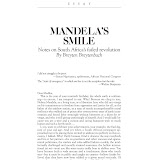 |
| Mandela's Smile |
In light of the new opportunity for Havergal students and staff to travel to South Africa this summer, I thought I would post a brilliant article by Breyten Breytenbach published in Harper's Magazine (Dec 2008). On this exchange, Havergal will be building a partnership with NOAH
Subscribe to:
Posts (Atom)

